Showing posts with label Black Lightning. Show all posts

Monday, February 24, 2020

Black Lightning Strikes Out!


Black Lightning - Cold Dead Hands is a modern reworking of the Black Lightning concept by the Tony Isabella, the characters creator. It's a modern comic book story with modern comic book art and that means for this fanboy it's an inferior outing compared to its Bronze Age source.


I give Isabella credit for trying to make this reimagined Black Lightning fit into the world of the modern day, a world in which young black men are shot down for far too little reason far too often. Once again we have the teacher-hero who returns to elevate the lives of the children and bring them hope. But in this case, the teacher-hero smacks too much of the type I don't like, given credit for charm but showing little evidence of labor and gifted with interested and bright students just eager for a chance. No one ever does the struggle of battling the system on behalf of kids who don't care for the battle to be fought, but Black Lightning came the closest. This version has too much Freedom Writers aroma for me, even if Jefferson Pierce is black.


And the Black Lightning here is not alone, but we are forced to encounter an avalanche of back up characters, most far too swiftly. The modern art makes identifying characters difficult in the best of times and saddling the reader with lots of pretty much identical people makes it almost impossible to keep up. And then there are shape-shifters too.


The villain in this story is Tobias Whale, but in contradiction to the original we get a black Whale, the albino villain trope being cast overboard in this instance. Unfortunately the bleached white skin in opposition to Jeffersion Pierce was much of the thematic undercurrent of the series. He's not as scary and doesn't feel nearly as memorable.


And where did all the fucking aliens come from. It seems the DCU is now rife with aliens around every corner. I'm not sure if this is the way it is these days, but these sci-fi touches really scratch gashes in the realism  a series like Black Lightning is supposed to have.


This is a more powerful Black Lightning too, a man with an electrical field and a suit that makes the most of it in some creative ways. I'm worried that Black Lightning is too powerful, too far removed from his "blaxploitation" fisticuffs mode, but I can handle that change I guess.


All in all this was a much less compelling read than the original or the nineties revival. It lacked the chutzpah of both of those series and as pretty as it could be was at times just plain confusing.

Rip Off

Sunday, February 16, 2020

Black Lightning Strikes Back!


By the time Tony Isabella was writing the adventures of his creation Black Lightning once more the world had changed, at least the world of comic books. In the early 90's when this series dropped the gandiose Image style was ascendant and that bombast is evident to some degree in this comic, sometimes to its detriment. Eddy Newell is a dandy artist, but the storytelling loses its way on occasion. "Brick City Blues" tells us of the 90's when the evil of Crack cocaine was the dominant drug of choice for the folks on the street and the "War on Drugs" was in full swing. (Lacing any foreign conflicts we decided to wage war on ourselves to keep the juices flowing.) That the "War on Drugs" was a debacle is well documented now with even Republicans wanting to garner some pity from above by seeking to modify prison sentences.


"Brick City" is an area of Cleveland, or at least that's what is on  Isabella's mind. Olympian Jeff Pierce is teaching again, bringing his talents to Brick City to dazzle the his tiny classes with inspiration and positive thinking. I have to confess that this kind of "hero teacher" trope is one of my least favorite and has done harm to my profession, one which I'm wrapping up after three decades and a bit. The public thinks all it takes is a little razzle dazzle and clever quotes from Whitman and children can be elevated and rescued from frightening home scenarios. It's actually a lot of hard tedious dogged work by folks who only want to find a few minutes for lunch who make the difference, that is if the powers that be will let them alone long enough.


I shouldn't take all my animus on these "hero teachers" out on poor Jeff Pierce, as he's better than many fictional teachers I've tumbled across. But if I knew that I could send an electrical tingle down the arm of my least favorite student once in a while, I might be proud classroom warrior for justice too. I've always said you are not a teacher unless you don't imagine the discreet use of a little electricity might not improve the gig.


But it's not just about Jeff Pierce in this one, it's about Black Lightning, the new superhero in town. He gets some help from the diligent cops and less from the others. He's seen partly as a nuisance unless he's just saved your personal bacon. The main baddie in the first several issues, aside from assorted gang-bangers, is a chap dubbed "Painkiller" who has an assortment of powers, he can either make you numb where he chooses or he can affect your senses, making you blind for instance. Black Lightning's electric field seems to give him just enough of an immunity that the two can fight ferociously.


Just like in the original series by Isabella, this one features a gritty realism in that death strikes quickly, surprisingly and without remorse.


One of my favorite issues is the one when Black Lightning is recuperating from his battles and a near-death experience. The inside view of his thoughts really make the character stand out.


Isabella wraps up his return to the Black Lightning with a trio of tales involving the Metroplois hero Crimebuster. It's a convoluted yarn and not as as good as the first series, though it does to some extent offer up an ending of sorts. It's not discussed but Isabella is taken off the book as well Newell who got a lot of help in these final issues.


When the story picks up we have a new writer and a new artist and they are quick to make some changes to the status quo of the series. Jeff Pierce fights for his job and the Black Lightning operates in the shadow of a deadly serial killer. A villain from his past resurfaces as well.


For a time Lightning himself is thought to be the villain, but it's eventually cleared up with some "outsider" help in time for the series finale. And unlike the first Black Lightning series, this one does get some closure.

Rip Off

Sunday, February 9, 2020

Black Lightning Strikes Again!


Black Lightnng proved too good a character to let disappear when the original series passed away during the great comic book implosion. Jeff Pierce was a smart and adept black man who wanted to bring justice to Suicide Slum and those were stories needed telling. So what to do?


World's Finest, the longtime home of Superman and Batman tandem was a dollar comic for a time and had room to rent to aspiring heroes and heroines looking for a place to next. Hawkman and Hawkgirl too up residence as did Captain Marvel / Shazam. Green Arrow had been there in the pre-dollar days and that left room for one more and Black Lightning stepped in.


Written by Denny O'Neil and drawn by Dick Dillin, George Tuska, and Rich Buckler among others the stories sadly were not that strong. O'Neil didn't get Isabella's take on Black Lightning and instead of a good man pretending to be a brash superhero we get just the former, a hero full of platitudes all too eager to call attention to the color of his skin. 


The fight against the underworld continued but the private life of Jefferson Pierce was almost never dealt with aside from a few antique references to mimeographing some tests. (That was a blast from the past, I'll say that.)


Things were a little better when Black Lightning guest-starred alongside Superman. The threat is from the school Pierce works at and that helps, but the absolute oddness of the threat is not the kind of thing Black Lightning ought to battling. He doesn't do aliens. '


Which is pretty much what he told the Justice League of America when they checked him out for membership, In classic Silver Age style they tested  him under the guise of presumed villains but it felt weird and in the end he turned them down. 


One excellent thing about the two-parter, a favorite of mine from this era of the JLA, is that Dick Dillin and Frank McLaughling drew Black Lighting exceedingly well. His costume really had snap and I got a real sense of what should look like. It had seemed rather drab really from the get go, a side effect of Vince Colletta's inks (I generally like Colletta, but he doesn't hit the mark on his turn on Black Lightning). 


Then it was off to Detective Comics, also a dollar book as Black Lightning closed out his Bronze Age career. 


He looked quite sharp alongside Batman when Dick Giordano drew him as they worked in parallel mostly to stop a deadly gang of gas theives. 


But it was in the last two installments of his run that new writer J.M DeMatteis and artist Gerald Forton really hit the ball out of the park. Suddenly the personal life was back and the school was front and center and the whole thing felt exactly right. The tone of the character was the strongest it had been since Isabella's departure. 


And like that it was over. Black Lightning finished out his run and then went on to join Batman in the replacement comic for The Brave and the Bold -- The Outsiders. Drawn by Jim Aparo (as he was in his Who's Who entry he looked quite sharp. (See the cover at the very top of this post.)


It would be some time before he'd return again under the hand of his creator Tony Isabella. That's coming soon.  

Rip Off

Sunday, February 2, 2020

Black Lightning Strikes!


The 70's were a rollicking time in the comic book sphere. After decades of relative security the big publishers saw the entire industry disappearing sooner than later despite lots of publicity. Veterans who had been at the helm since the beginning were retiring and new talents were stepping aboard what seemed to many a sinking ship.


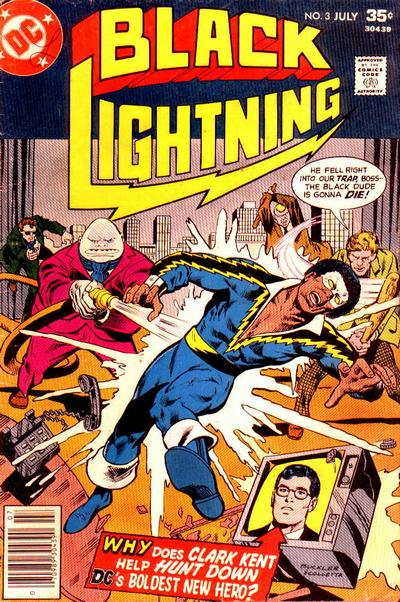
A boy from Cleveland named Tony Isabella was one such youngster come to New York City to make good in the business he loved. At first he worked at Marvel doing what needed doing but eventually he found his way to DC and there he found a company desperate to find relevance with an audience they scarcely understood and in many cases had a loathing for. Isabella was told he had control over the project but was not in on the choice of artist Trevor Von Eden, a sixteen year-old artist which immense promise who just happened to be African-American to boot. Inspiration struck on the cover of Wonder Woman.


The name "Black Lightning" was evocative for sure and for a writer who had left behind stints on Luke Cage Hero for Hire and Black Goliath a vehicle to bring some modernity to the house Superman built. Black Lightning wasn't an alien, a somewhat deranged knight, nor even a mutant. He was a man, a black man from the depths of Suicide Slum (first created as the home of the Newsboy Legion by Jack Kirby and Joe Simon decades before) in the heart of Metropolis. This was the "other side of the tracks" where Superman didn't necessarily spend most of his time, this was a place needing heroism of a smaller kind but a kind no less potent in their daily lives.


Jefferson Pierce was an Olympic decathalete, a man of skill and training who came back home to teach in the local high school, to try to do some good. But events led to the tragic and ignoble death of one of his students and a need for a more direct approach seemed all to evident. Getting help from his mentor Peter Gambi, a tailor who lived beneath him, he created an identity with an electrical pop. He donned an Afro wig, not all that different than blonde wig worn by  Black Canary, a statement and to some extent a distraction. He quit being Pierce and became Black Lightning and the criminals of Suicide Slum were about to pay the price.


Black Lightning's central enemy is Tobias Whale, a crime boss who reminds me a bit too much perhaps of the Kingpin, but who is a pretty nasty customer nonetheless. He part of the One Hundred, an uber-gang of villains I first remember coming across in the Rose and Thorn stories.


Being in Metropolis he has to tangle with Superman of course. There's no practical way a small-timer like Lightning can hang and bang with a world shaker like Superman, but Isabella finds a way for them to clash and then work together.


The original eight issues have an arc to them as Pierce finds out more about the people around him. It makes his story all the more tragic in the end, but adds fuel to his sense of mission.


Tony Isabella dedicates the first eight issues of Black Lightning to his wife Barbara and they are I guess as close to the ideal for his hero as he could get at the time. Black Lightning will only last a hand full of issues beyond this story line. 


After defeating the One Hundred (or at least the Metropolis branch) Black Lightning needs a mission and finds it in trying to save some school kids from a terrorist dubbed "The Annihilist". It's pretty good story that brings out all the strengths of Black Lightning's character.


Less impressive is his clash with The Trickster, a Flash rogue moved over to give him trouble as BL tries to protect a jewel or something like. There's also a bogus Black Lightning in this story, but that part of the yarn is pretty good.


Black Lightning's book comes to a close with the eleventh issue as the great "DC Implosion" takes him off the newsstands for the time being. Denny O'Neil had stepped in to write what became the last regular issue and the changes in tone are evident.


It's still O'Neil but this time with Mike Nasser on what was to be the final issue of Black Lightning, a comic never published save in Cancelled Comics Cavalcade #1, but now available in beautiful full color in the first Black Lightning collection. 


Rip Off

I Have Heard The Word!

Rip Off