Showing posts with label Dark Horse Comics. Show all posts

Sunday, May 24, 2020

And The Rocketeer's Red Glare!


With the possible exception of Jack Kirby Fourth World saga, I likely more different versions of The Rocketeer by Dave Stevens than any other story. This is at once a delightful and evocative story which was told by Stevens in achingly slow chapters over the course of many years and at several different publishers.


It began at Pacific Comics in the back pages of Starslayer and then Pacific Presents before shifting over to Eclipse Comics and then Comico Comics and finally Dark Horse Comics. The current publisher of the full saga is IDW and I've just recently picked up the paperback trade version to add to my many other iterations of this beautiful story.


 Each time I read this raucous yarn, I'm transported back to an imaginary quasi-historical era of heroic adventure when the world was vast and the promise of youth was bountiful, not just in the setting of the story but in my own life as well. It's a time trip of the most invigorating kind.

Here are the covers of some of the versions I own in addition to the original Starslayers.


Rip Off

Saturday, May 23, 2020

The Slayer Of Stars!


Mike Grell's Starslayer is an important comic book series. When the Independent market developed, it needed talent and one of the first big names to cross over into this wild new frontier was Grell. He'd made a name for himself at DC on the Legion of Super-Heroes (where he'd replaced Dave Cockrum) and on Green Lantern and Green Arrow (where he'd followed Neal Adams, albeit after a many years hiatus). So he'd been trusted with big titles and had proven a solid talent. Now I have to confess that Grell in these years was not my favorite, his stiffness when dealing with anatomy weakened his efforts for me considerably, but there was no denying his skill at splendid finishes. 


Starslayer had a six-issue run with Pacific Comics alongside the pioneering Captain Victory by Jack Kirby. And it was in the back pages of Starslayer thatn Dave Stevens introduced the world to The Rocketeer. After the initial storyline though Grell took the project to First Comics where others worked on it with him overseeing the efforts while he focused on Jon Sable Freelance. And it was about this time, or little later that I left behind the Indy books to keep money and effort aside for a new family. I traded most of my Indy books away at some point, but the first two issues of Starslayer did not go because of The Rocketeer's appearance. (More on The Rocketeer tomorrow by the way.)


And before you knew it the 80's gave way to the 90's and Image and Valiant joined the comic book fray. I was hard into Valiant, but generally stayed away from their Windjammer brand which took material outside the exquisitely developed Valiant universe and offered it up to the folks at home.


One project was Mike Grell cracking out Starslayer again and revising   to suit his new attitudes, giving us a "Director's Cut".  Never read it, but recently I hankered to read Starslayer again and there was this collection which put the "Director's Cut" issues together. Despite warnings about printing woes I  chanced it and found the return to the Starslayer universe uneven.


The finisher on these pages are developed by some other artists, presumably under Grell's direction and the new pages don't really blend all that well with the original stuff and don't add at all to the fundamentals of the story.


Since I suspect few came to this without some prior knowledge of the character, the fact is the new material actually undermines some of the best moments such as the reveal at the end of the debut issue. We think we are following a Celtic warrior as he fights for his family and his tribe but in the last few moments we are jumped forward into a science fiction future with space ships and robots and all sorts of stuff. It was a  nifty twist all those many years ago and this telling makes that less effective by quite a bit.


The story of Starslayer is a pretty good one, a warrior catapulted into the future when Earth has colonies across the solar system, but a dark future since the Sun has turned into a red giant and consumed Mercury and devastated Venus. We meet humans of all kinds bred to be in tough environments but bringing customs from a recognizable human history.


Torin McQuillon the Starslayer and the woman who brought him into the future Tamra fight together aboard the Jolly Roger, a sleek and fast spaceship. Torin can function in this brave new world because of SAM, a robot that translates and does other things to make him suitable for this new environment. There are too many Bogie jokes for my tastes, but that seemed to be a theme Grell really wanted to fasten down.


The maguffins in this story are amulets given to each of the colonies which Tamra needs to help save Earth, or at least that's what we're led to believe. There are a few twists and turns, but that's fine by me. It's been long enough since I've read this that I was enjoying it quite well, that is when the artwork let me.


I cannot really recommend this collection because of the printing problems, but if the story seems appealing it might be an option, certainly a convenient one.

Rip Off

Sunday, April 19, 2020

What To Shmoo With A Super Shmoo!


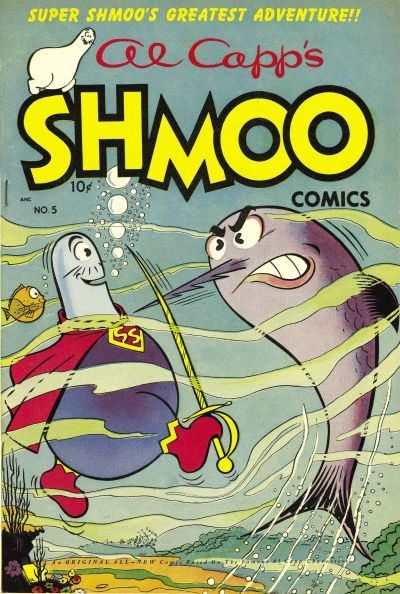
Shmoos were a hit! So much so that merchandising of all kinds flowed into the marketplace of baubles and beads and more. Of the more some was comic books. Li'l Abner had been a comic for a while, so it was a snap to spin off All Capp's Shmoo Comics. These are not done by Capp but by others and in all fairness the comics make no secret of this fact.


The essential elements of the Shmoo curse (or blessing depending on your attitude) are established in issue one. To give the comic a perspective we get Washable Jones, the Huck Finn of Dogpatch who has come to love the Shmoos and takes care of them as much as they take care of him. The Shmoos are just a part of the fabric of life in Dogpatch and things seem to be going quite well for the most part. Through all five issues of the series Washable and his Shmoos (who are mostly props and not proper characters) fend off others who wish to mistreat them, Washable also goes on epic journeys to the Moon and elsewhere.


But introduced early on is the delightful Super Shmoo, a Shmoo unlike the others. In his naive Shmoo existence filled with punny Shmoos of all kinds Hugh Shmoo is struck by lightning and changed into Super Shmoo who is able to do whatever needs doing to uplift and improve Shmoo kind. His antics are utterly whimsical and jammed with as many Shmoo puns as the writers can dream up. It's this wonderful compression of little jokes relentlessly popping out that makes reading the Super Shmoo stories so much fun, better than the other Shmoo stuff in these issues.


After the "Expidishun to the Shmoon" cover the Super Shmoo takes the helm as the mascot of the comic book.


Super Shmoo even meets and helps Santa Claus. Now that's heroism.


In addition to the five issues of Shmoo comics this volume also offers up the Al Capp's Shmoo comic giveaway  mini-comic.


The second issue of Shmoo Comics was reprinted a year or so later with Washable Jones taking the lead spot.


The Shmoo craze came and went like all crazes do, but it left us some delightful evidence of its existence the comics are among the niftiest examples. They don't rise anywhere near the sharp satire of the comic strip, but they funny diverting comics nonetheless.


Tomorrow more Shmoo madness.

Rip Off

Saturday, April 18, 2020

Into The Valley Of The Shmoon!


Al Capp's Lil Abner is one of the legendary comic strips, a rambunctious and vivid satirical farce that was the talk of the town in the first half of the 20th Century. The inhabitants of Dogpatch, the mythical backwoods hamlet in which Abner and his family and friends lived was a must-visit destination for countless Americans. And it seems rarely were they more interested in visiting than when Dogpatch was overrun by the Shmoos. 


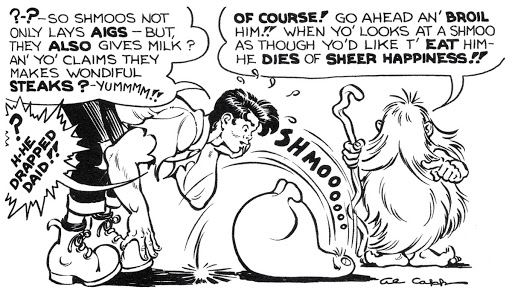
The Shmoos come from the Valley of the Shmoon, a hidded vale even from the denizens of Dogpatch, but circumstances take Abner there where he meets a hirsute hermit who acts as the guardian of the gateway to the valley and who offers up his dire warnings about humanity interacting with the cute and exceedingly compliant Shmoos. He says that it will lead to the downfall of mankind if the Shmoos escape from their valley.


What the Shmoos offer mankind is a life free of want. Human economy is built around scarcity and we work presumably so that we can fulfill our needs and perhaps even our wants. But what if each human was suddenly free of the need to scour for needs? What if we had our basic desires available to us at no cost the save perhaps the labor we invest in acquiring them now. Well according to Al Capp, the Shmoos can offer mankind an endless supply of tasty morsels from their own bodies and when they are broiled they taste like steak, boiled like ham, and give us eggs and butter and more besides. 


In volume two Dark Horse's two-volume comprehensive look at the Shmoo phenomenon we have all the strips which dealt with the Shmoos from their debut to the end of the series itself, a span of decades.


When the Shmoos first arrive they fascinating creations and charm the entire country which promptly goes on something of a Shmoo craze with countless Shmoo items being produced. (More on those in a later post.) The Shmoos invariably smile and especially when they happily die to supply our desires. They free us from want and so it's presumed by Capp rob us of the incentives which drive work and spark creation. (To be fair he seems of two minds on this.)  But that's hogwash, a belief system built to keep people enslaved to the world of work which creates wealth not for the many but for the few. The Shmoos destroy that trickle down world, and allows us all to live like kings and queens. Can it succeed? It did quite well on Star Trek! (Oh that was just a fantasy! Don't I know it!)

Rip Off

I Have Heard The Word!

Rip Off