Showing posts with label Vince Colletta. Show all posts

Saturday, June 27, 2020

The Daredevil In Yellow!


Daredevil was the comic without fear. Marvel was on a dandy run, creating new heroes every month and growing in response to fan demand. Stan Lee had found a formula for success which leaned heavily on artists Jack Kirby and Steve Ditko for the hits which changed the face of comics and made the Silver Age profoundly different and profoundly modern. 


Taking the approach which had worked on Fantastic Four and Spider-Man, Lee turned to Bill Everett, the Golden Age creator of the Sub-Mariner. That lasted exactly one issue. Everett was a master in his time but his Daredevil look positively antique, well-crafted but of a different era.


Lee turned to EC veteran Joe Orlando to take up the slack and inked by Vince Colletta the comics looked more like what Marvel was doing elsewhere. 
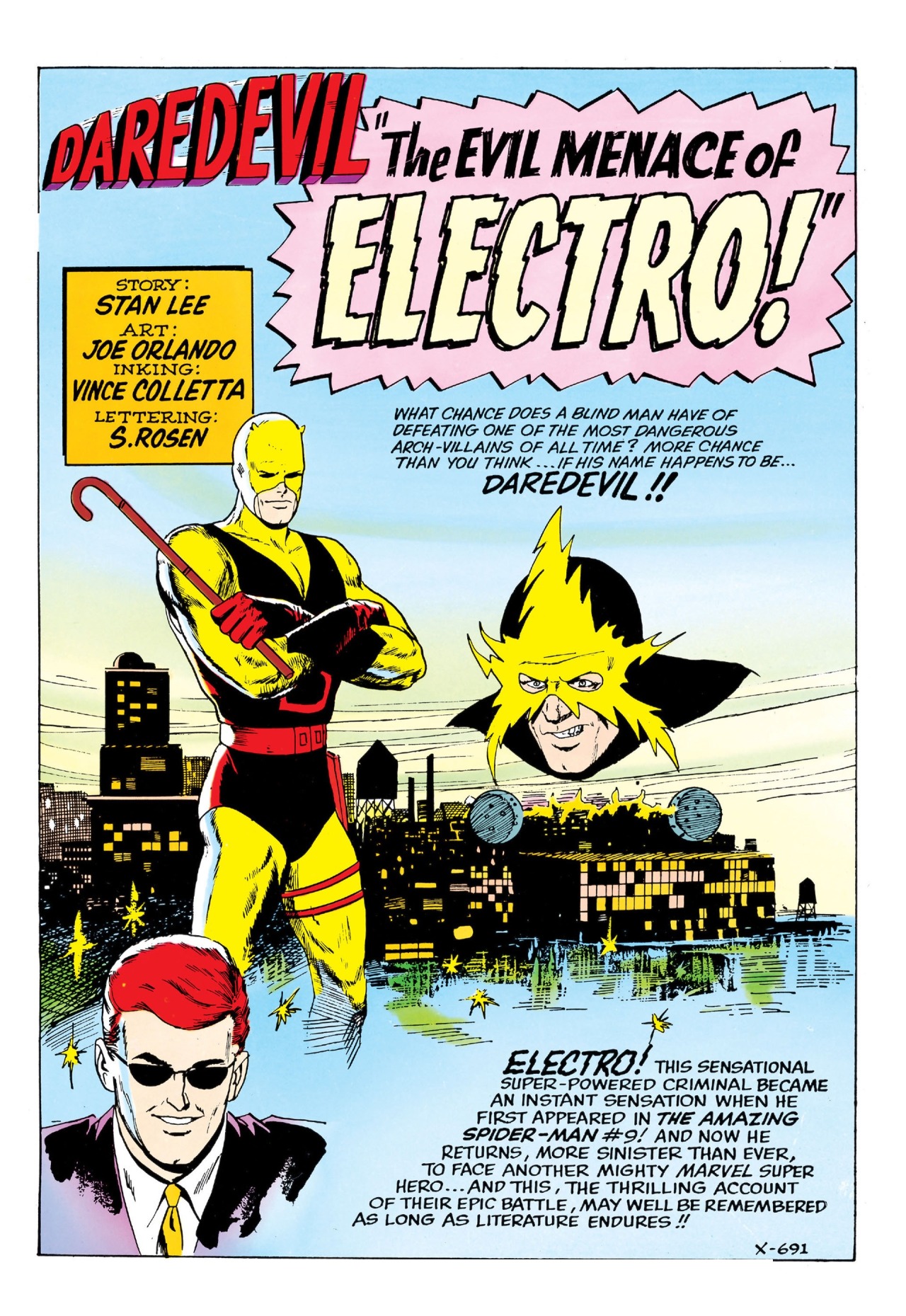
Marvel Comics Title Pages — Daredevil vol.1 #2 (1964) - The Evil ...
Despite battling the borrowed Spidey villain Electro and running up against new foes like The Owl and The Purple Man, Daredevil seemed to be a comic which was sputtering. 


Even the soon-to-be-obligatory crossover with Spider-Man himself under the penciling hand of Steve Ditko himself only showed what might be missing from the Daredevil comic itself. The stories were good, but felt like stories which might've been produced a decade before. 


And then Joe Orlando's old partner Wally Wood took the helm of the book and brought a true-blue big name feel to a book which in truth had been put together by many qualified veterans. Wood brought something which had been missing despite all the good intentions -- excitement. Admittedly the Matador was an opponent inspired by Daredevil's little horns, but he did look good. Mr. Fear and his partners the Ox and the Eel were a blend of old and new but looked fresh nonetheless. 


But most importantly Wally Wood identified the problem with Daredevil pretty quickly -- the costume. The yellow and black and red fighting togs which DD had put together were right out of the Golden Age of comics, something you'd see someone on the Justice Society of America wear maybe.. Quickly  Wood added a bit of dash with another "D" to the chest symbol. Now Daredevil was "DD" formally for all the world to see. But Wally Wood wasn't done yet. More tomorrow.

Rip Off


Saturday, February 22, 2020

Goliath In Black!


Tony Isabella has crafted a reputation for writing black heroes. His creation DC's Black Lightning being  the most famous of his outings in this arena. But he began at Marvel and there he wrote some singular issues of the comic Luke Cage, Power Man and later he crafted the earliest adventures of Black Goliath.


In the debut issue of Black Goliath (smartly drawn by George Tuska and Vince Colletta) we meet the fifteen foot giant who is in his off hours Bill Foster, a talented bio-chemist who had in earlier days assisted Henry Pym and it was there that he'd "perfected" the growing formula which Pym had dabbled with for many years. In that first issue we find a Goliath who is reminiscing about his early days in the Watts community and who ends up fighting some low-level criminals he chances upon. Later we learn that Foster is a man in full command of his power, who can elevate to fifteen feet on a whim and who is running a research lab manned by three up and coming talented young scientists. He seems to be a man well positioned for a successful life, but as we well know the lot of a superhero is rarely blissful..


We'd first met Black Goliath in the pages of Luke Cage, Power Man when the aforementioned Hero for Hire came to blows with the giant when he was searching for his lady love Claire Temple. Turns out Claire is the ex-wife of Foster and had joined him on the West Coast to help because she thought he was trapped at the fifteen foot size. Apparently this is a lie perpetrated by Foster to keep Claire close.


Black Goliath and Luke Cage face off, but both find themselves fighting as a duo against the Circus of Crime. 


I love the Circus of Crime, but this is not one of their most entertaining outings. Cage and Foster quickly dispense with them and Black Goliath moves on the headline his own title, but only briefly. 


Black Goliath only lasted four more issues and rated on visit with Spidey in Marvel Team-Up. Later Bill Foster changed his fighting name to Giant-Man and fought alongside the Thing in Marvel-Two-In-One. He became a background character at Marvel for many years.


Always it seemed he was a hero looking for a place to fight, a time to show his worth. The very stuff of tragedy. 


On a final note, let me that I always loved the corner box image for these the Black Goliath comics, brief though was their stay. 

Rip Off

Thursday, February 20, 2020

Speak-Out Series - In The Days Of The Mob!


Here's a real behind-the-scenes treat from a Bronze Age rarity. In the Days of the Mob was along with its companion Spirit World an attempt by Jack "King" Kirby to broaden the scope of comics at the time when the four-color pamphlet rule the racks. These DC products (though they squire the "Hampshire") were one-offs, the next issues of each project being broken up and published here and yon across the DC Universe.


This seems to be Kirby's sketch for the cover of the second issue. Kirby loved to make use of photos and he did a lot of collage work in these books, most notably on the cover of In the Days of the Mob. Here you can see his few pencils with space provided for the assembled images. Below is an ad for the never-to-be-seen second issue from the first.


Kirby clearly loved dealing with this violent but fascinating period of time as he came back to it time and again. It's a shame he couldn't have done a few more issues of what is clearly a work of love for a time when he was a mere lad. Here's a link to the "Bullets for Big Al" story and some other things as well. And here's a link for the "Murder Inc." story which did see publication but not in the second issue of In the Days of the Mob as intended. And finally here's a link , that has the whole debut issue scanned in, save for the John Dillinger poster below.


Here's an original page from the second issue perhaps, inked by Vince Colletta. Mike Royer was inking Kirby by the time the second issue stories were done. So this Al Capone full-page is a puzzler.


Here are some lush Kirby double-page spreads by the King.


And here's a delicious ad for the magazine.


I have a remote memory of seeing In the Days of the Mob at my local store, stacked high up above my childlike ability to reach, clearly intended for adult attentions. I wanted it still and all. DC has reprinted these stories in a handsome hardback format and if  you're a fan of Kirby's like I am, it is a necessary addition.

Rip Off

Friday, February 14, 2020

Speak-Out Series - Soul Love!


It's the Kirby book that never existed, but which I've long wanted to have. In a brilliant tour de force John Morrow and his mates at Twomorrows Publishing have reached back into the misty depths of comic book history and corrected a mistake made by DC when they failed to publish the mostly ready Soul Love magazine, part of Jack Kirby's "Speak-Out Series". The stories were written, drawn and in some cases inked but the enigmatic leadership at DC kiboshed the deal before it could reach fruition.


Soul Love was the magazine DC said it wanted when they blinked at Kirby's proposed True-Life Divorces offering. But then they blinked again and we were robbed of seeing how the "King of Comics" dealt with the day-to-day culture of African Americans in the early 1970's. You might think us all spared the indignity when a middle-aged Jewish man tried to plumb the inner thoughts of young black men and women. But Kirby gave it a go and John Morrow has finished the thought. It's far from perfect, just what you'd expect in so many ways, but still and all it's part of the lore of comic book days gone by and I for one am delighted to have gotten the chance to read it.

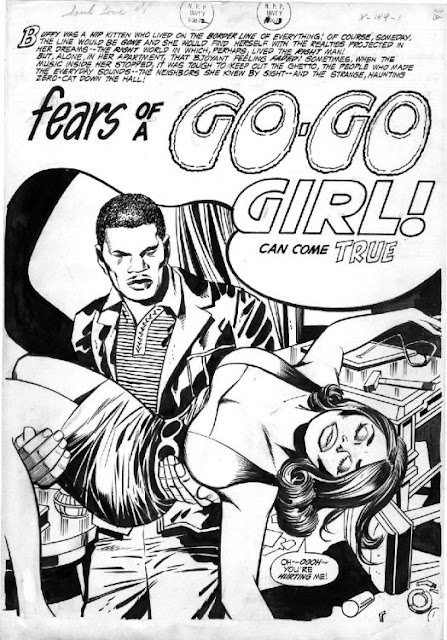
Image result for soul love fears of a go go girl jack kirby

"Fears of a Go-Go Girl" is a pretty rough outing with the titular young woman torn between an unreliable fellow who might do her career some good to boot and the quiet and somewhat mysterious man who watches over her. It's not a story about stalking, though with a quick twist it could be. Instead it's a much less contrived romance than many of the ones to follow. 

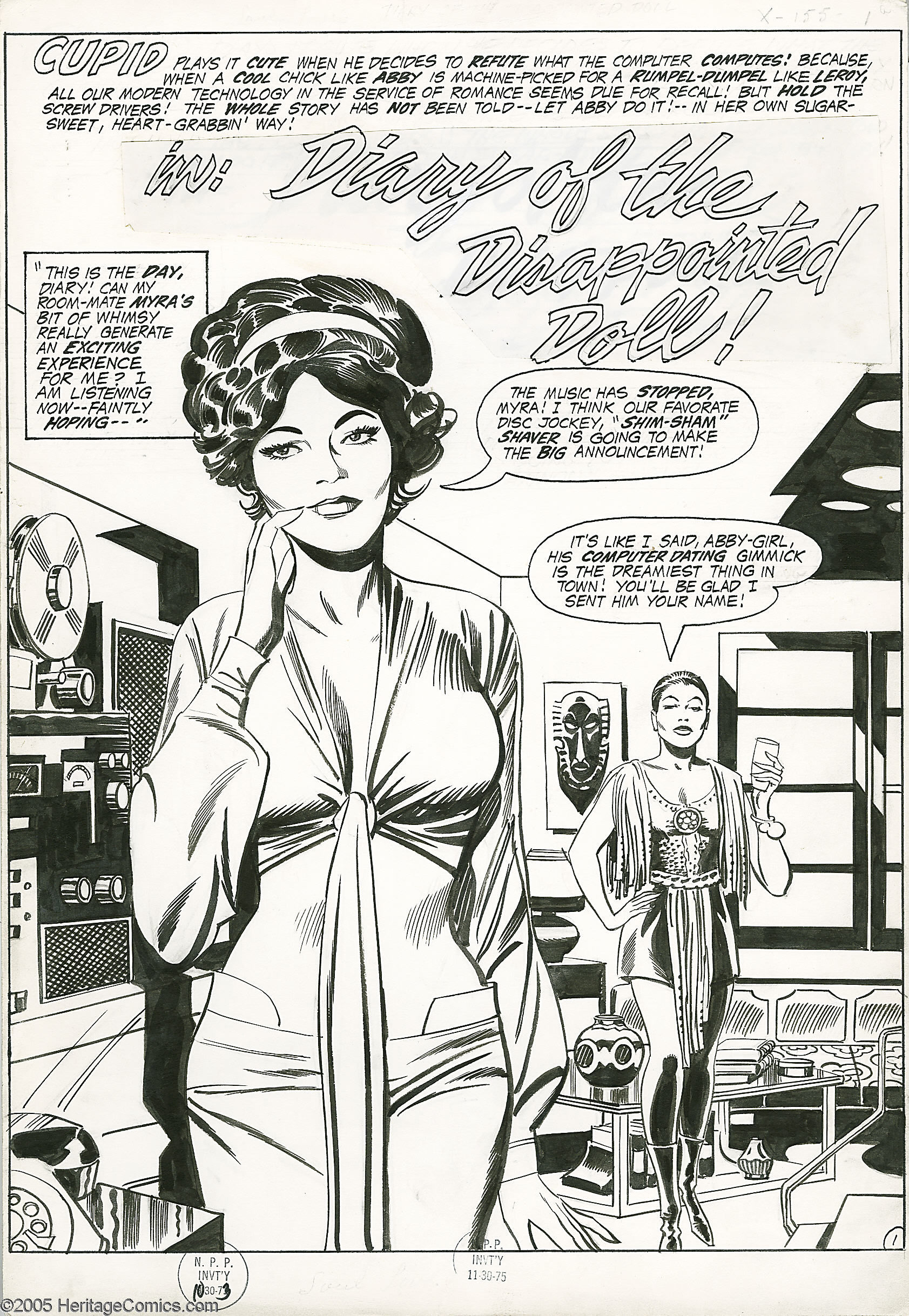
Image result for soul love fears of a go go girl jack kirby

Vince Colletta inked most of these stories, but "Diary of a Disappointed Doll" was done by Tony DeZuniga and it makes yearn to have seen more of him on Kirby's work. But the art aside we have a dame here who gets a date from a radio station by dint of computer, and it's not what she expects in so many many ways. 


"Dedicated Nurse" is a pretty uncomfortable story, certainly a product of a time when despite the myriad shapes, sizes and weights humans have always had, the ideal is the preference even at the cost of the what is really real. I'm not sure I liked this story much, it's resolution felt really off base.


Image result for soul love old fires jack kirby

"Old Fires" is little two page vignette has some really nifty moments, well really moment. It's a conversation in which truth emerges, not something talking usually does. I liked it a lot. 

Image result for soul love the teacher jack kirby

The Twomorrows folks left this story in its raw form. "The Teacher" shows the lengths gone to in attempting to transform the distinctiveness of Kirby's work into the typical DC patterns. The irony is rich in that the black faces in this story have been "whited out" extensively to make the DC folks happy. I've never heard of "White Face" before, but we might have an example here. 


Soul Love is available in two formats, as part of the Dingbat Love hardcover (how I have it) and as a standalone issue attempting to mimic the look of the magazines original intent. Those latter ones are produced in very limited supply, so move quickly if that's your desire. I'll keep what I have -- a new Jack Kirby magazine. Hooray!  

Rip Off

Sunday, February 2, 2020

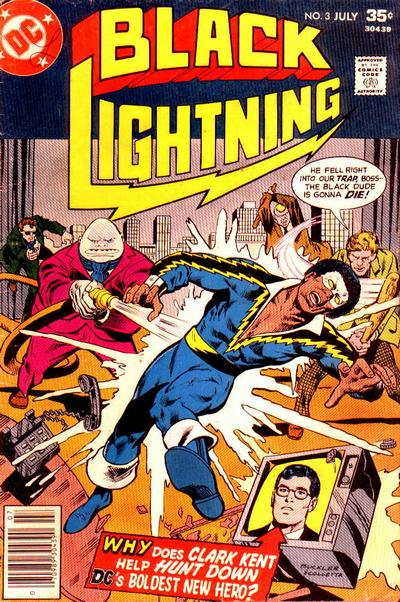
Black Lightning Strikes!


The 70's were a rollicking time in the comic book sphere. After decades of relative security the big publishers saw the entire industry disappearing sooner than later despite lots of publicity. Veterans who had been at the helm since the beginning were retiring and new talents were stepping aboard what seemed to many a sinking ship.


A boy from Cleveland named Tony Isabella was one such youngster come to New York City to make good in the business he loved. At first he worked at Marvel doing what needed doing but eventually he found his way to DC and there he found a company desperate to find relevance with an audience they scarcely understood and in many cases had a loathing for. Isabella was told he had control over the project but was not in on the choice of artist Trevor Von Eden, a sixteen year-old artist which immense promise who just happened to be African-American to boot. Inspiration struck on the cover of Wonder Woman.


The name "Black Lightning" was evocative for sure and for a writer who had left behind stints on Luke Cage Hero for Hire and Black Goliath a vehicle to bring some modernity to the house Superman built. Black Lightning wasn't an alien, a somewhat deranged knight, nor even a mutant. He was a man, a black man from the depths of Suicide Slum (first created as the home of the Newsboy Legion by Jack Kirby and Joe Simon decades before) in the heart of Metropolis. This was the "other side of the tracks" where Superman didn't necessarily spend most of his time, this was a place needing heroism of a smaller kind but a kind no less potent in their daily lives.


Jefferson Pierce was an Olympic decathalete, a man of skill and training who came back home to teach in the local high school, to try to do some good. But events led to the tragic and ignoble death of one of his students and a need for a more direct approach seemed all to evident. Getting help from his mentor Peter Gambi, a tailor who lived beneath him, he created an identity with an electrical pop. He donned an Afro wig, not all that different than blonde wig worn by  Black Canary, a statement and to some extent a distraction. He quit being Pierce and became Black Lightning and the criminals of Suicide Slum were about to pay the price.


Black Lightning's central enemy is Tobias Whale, a crime boss who reminds me a bit too much perhaps of the Kingpin, but who is a pretty nasty customer nonetheless. He part of the One Hundred, an uber-gang of villains I first remember coming across in the Rose and Thorn stories.


Being in Metropolis he has to tangle with Superman of course. There's no practical way a small-timer like Lightning can hang and bang with a world shaker like Superman, but Isabella finds a way for them to clash and then work together.


The original eight issues have an arc to them as Pierce finds out more about the people around him. It makes his story all the more tragic in the end, but adds fuel to his sense of mission.


Tony Isabella dedicates the first eight issues of Black Lightning to his wife Barbara and they are I guess as close to the ideal for his hero as he could get at the time. Black Lightning will only last a hand full of issues beyond this story line. 


After defeating the One Hundred (or at least the Metropolis branch) Black Lightning needs a mission and finds it in trying to save some school kids from a terrorist dubbed "The Annihilist". It's pretty good story that brings out all the strengths of Black Lightning's character.


Less impressive is his clash with The Trickster, a Flash rogue moved over to give him trouble as BL tries to protect a jewel or something like. There's also a bogus Black Lightning in this story, but that part of the yarn is pretty good.


Black Lightning's book comes to a close with the eleventh issue as the great "DC Implosion" takes him off the newsstands for the time being. Denny O'Neil had stepped in to write what became the last regular issue and the changes in tone are evident.


It's still O'Neil but this time with Mike Nasser on what was to be the final issue of Black Lightning, a comic never published save in Cancelled Comics Cavalcade #1, but now available in beautiful full color in the first Black Lightning collection. 


Rip Off
I Have Heard The Word!

Rip Off